

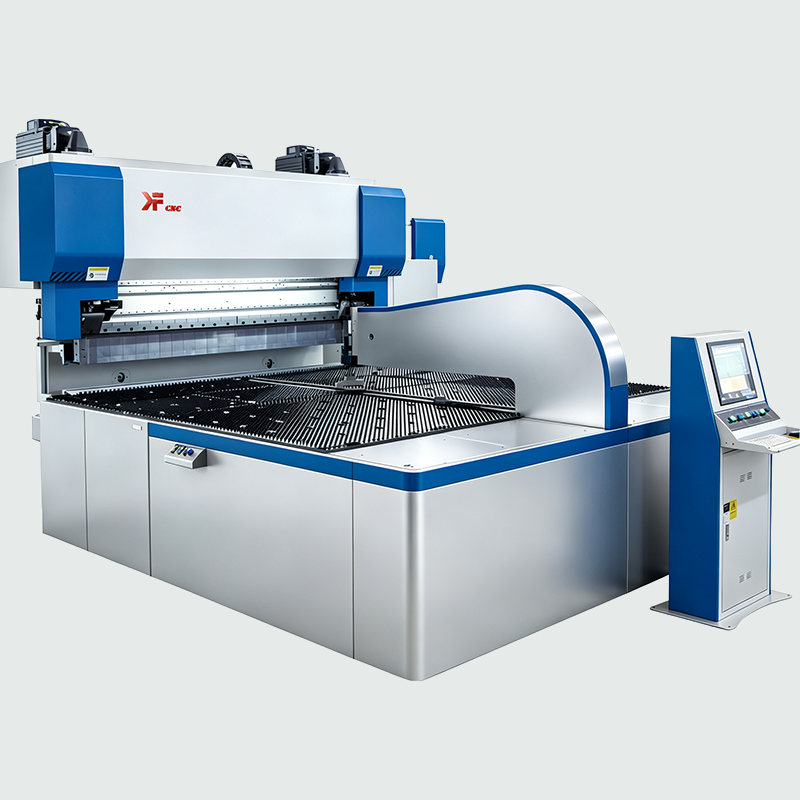
Choosing between a panel bender and a CNC press brake is one of the most common decisions a sheet metal shop faces. Both bend metal, but they are built for different production realities. This guide compares them on the factors that actually affect your cost per part: part geometry, tooling, labor, changeover time and volume.
What a panel bender does best
A panel bender (also called a panel bending center) forms a sheet by holding it down and sweeping a small universal tool along the bend line. The sheet stays supported and the operator does not lift or flip heavy panels. That makes it the strongest choice for large, thin, flat panels with many bends — cabinet enclosures, electrical panels, elevator panels, metal furniture and decorative facades.
Because the tooling is universal, a panel bender needs no per-part punch or die set. A job change is mostly a program change, so short runs and mixed batches are economical. A single operator can often run the machine, which is why shops use panel benders to reduce dependence on skilled press brake operators.
What a CNC press brake does best
A CNC press brake forms sheet between a punch and a die. It is more flexible on bend geometry: with the right tooling it handles tight inside radii, deep boxes, offset bends, hemming and thicker plate. If your parts are varied in thickness, need forming beyond simple flanges, or are made from heavier gauge material, a press brake is usually the more capable platform.
The trade-off is tooling and labor. Each part family may need its own punches and dies, setup takes longer, and moving large sheets in and out is physically demanding.
Side-by-side comparison
| Factor | Panel Bender | CNC Press Bend / Press Brake |
|---|---|---|
| Tooling | Universal, no per-part dies | Punch and die per part family |
| Changeover | Mostly a program change | Tool change and setup |
| Labor | Typically one operator, no heavy lifting | Operator lifts and supports the sheet |
| Best parts | Large thin panels, many bends, flat enclosures | Deep boxes, tight radii, thick plate, mixed geometry |
| Repeatability | High once programmed | High, depends on tooling and operator |
| Investment | Higher machine cost, lower tooling cost | Lower entry cost, ongoing tooling cost |
How to decide in three questions
1. What is your dominant part? If it is a flat panel with four bent edges and many parts share that family, a panel bender wins. If you make deep boxes, thick plate or one-off shapes, start with a press brake.
2. What is your batch pattern? Many short runs and frequent changes favor a panel bender. Long runs of one geometry amortize press brake tooling well.
3. What is your labor situation? If finding and keeping skilled brake operators is hard, the one-operator panel bender reduces that dependency.
A note on convex forming and cracking
When a panel needs an outward (convex) bend, material behavior matters more than machine class. Forming direction relative to the sheet's rolling direction, bend radius and material grade all affect whether the outer surface cracks. Ask your supplier to prove the bend on your actual material and thickness before you buy — not just on a demo panel.
See both processes in action
Watch a real KAFE CNC panel bending center forming panels without marks: servo panel bending center demonstration. For bending case studies and machine parameters, visit the KAFE CNC application case studies and our panel bender product page.
Jinan KaFe CNC Machinery Co., Ltd. manufactures both panel bending centers and CNC press brakes. Questions? Email marketing@kafecnc.com and we will respond within 24 hours.
Time of publication: 11-27-2026